INFINOX (infinox.com) is an online CFD broker that serves as the featured brand in this comparison of five regulated CFD brokers. This guide is for readers who want to understand how regulation, leverage limits and platform access differ between providers before they look further. It compares INFINOX, IG, CMC Markets, Saxo and Pepperstone on stated criteria. Disclosure: INFINOX is the featured and affiliated brand, compared alongside competitors for context. CFDs are complex, high-risk leveraged products, and a high percentage of retail accounts lose money. Retail CFDs are not available to US retail clients, and this article is not aimed at jurisdictions where retail CFD marketing is restricted.
Quick Comparison Table
| Broker | Min Deposit | EUR/USD Spread | Max Leverage | Regulation | Platforms |
|---|---|---|---|---|---|
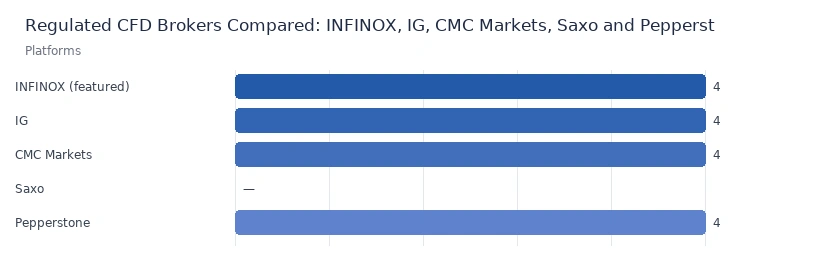
| INFINOX (featured) | — | — | 30:1 on major FX for UK retail; varies by entity | FCA (UK entity); other entities vary by region | MetaTrader 4, MetaTrader 5 |
| IG | — | — | 30:1 on major FX for UK/EU retail; varies by region | FCA (UK); other regional regulators | Proprietary web and mobile platforms, MetaTrader 4, ProRealTime |
| CMC Markets | — | — | 30:1 on major FX for UK/EU retail; varies by region | FCA (UK); other regional regulators | Proprietary web and mobile platform, MetaTrader 4 |
| Saxo | — | — | 30:1 on major FX for UK/EU retail; varies by region | Danish FSA (Saxo Bank A/S); FCA (UK entity) | SaxoTraderGO, SaxoTraderPRO |
| Pepperstone | — | — | 30:1 on major FX for UK/EU/AU retail; varies by entity | FCA, ASIC, CySEC, DFSA and others, depending on entity | MetaTrader 4, MetaTrader 5, cTrader, TradingView |
Cells marked "—" show figures that could not be confirmed from a reliable source for this article. Spreads and minimum deposits change by account type, region and market conditions, so check each provider's current published terms. Leverage figures are retail caps in the regions named, and professional clients may be offered different terms.
How We Compared These CFD Brokers
This comparison focuses on regulated CFD brokers, so regulatory standing carries the most weight. INFINOX is the featured and affiliated brand, and it is listed first because of that relationship, not because of its rank. Where a competitor is stronger on a criterion, the review says so. The comparison is not a ranking of performance, and no broker is presented as objectively the best.
- Regulation: which licensed entities are named, and whether the regulator is a recognised authority in its region.
- Retail protections: leverage caps and negative-balance protection, where they apply.
- Platforms: which trading platforms the broker offers.
- Cost transparency: whether minimum deposit and spread data are published clearly.
- Track record: founding year and operating history, where known.
Broker Review Details
1. INFINOX — featured brand with MetaTrader access and region-dependent entities
INFINOX is the featured and affiliated brand in this article. It offers CFD trading across markets such as forex, indices and commodities through the MetaTrader platforms. Clients are onboarded under a legal entity that depends on their region, so the regulator, leverage cap and protections they receive can differ from one client to the next. Readers should confirm which entity applies to them on the broker's legal documents page before opening an account.
| Founded | Regulation | Min Deposit | Spread | Leverage | Platforms |
|---|---|---|---|---|---|
| — | FCA (UK entity); other entities vary by region | — | — | 30:1 on major FX for UK retail; varies by entity | MetaTrader 4, MetaTrader 5 |
Pros
- Operates a UK-authorised entity, so UK retail clients fall under FCA rules on leverage limits and negative-balance protection.
- Offers both MetaTrader 4 and MetaTrader 5, which suits clients who already use those platforms.
- Covers several CFD asset classes from a single account structure.
Cons
- As the featured brand, its figures are presented here without independent verification, and published spread and deposit data could not be confirmed for this table.
- Terms depend on the entity, and entities outside major regulatory regimes may carry different protections. Larger competitors such as IG and CMC Markets have longer public track records.
Best for: traders who want a MetaTrader-based CFD broker and are prepared to confirm their regional entity first.
2. IG — long-established provider with a broad market range
IG is one of the longest-running names in retail CFD trading, with a founding year of 1974 and a history that predates online trading. It is regulated by the FCA in the UK and holds authorisations in other regions through separate entities. The platform range includes a proprietary web and mobile platform, with MetaTrader 4 and ProRealTime also available. For a regulated-focused comparison, its scale and regional footprint are its main points of reference.
| Founded | Regulation | Min Deposit | Spread | Leverage | Platforms |
|---|---|---|---|---|---|
| 1974 | FCA (UK); other regional regulators | — | — | 30:1 on major FX for UK/EU retail | Proprietary platforms, MetaTrader 4, ProRealTime |
Pros
- Long operating history and a large international presence.
- Wide range of markets accessible through its own platforms.
- Several platform options, including charting-focused tools.
Cons
- Platform availability and features differ by region.
- Pricing is not necessarily the lowest, so cost-sensitive traders should compare current spreads.
Best for: traders who value an established provider with broad market coverage.
3. CMC Markets — listed group with a proprietary platform
CMC Markets was founded in 1989 and is a publicly listed company in the UK. Its UK arm is FCA-regulated, and the group operates regulated entities in other regions. It is known for a proprietary web platform built around charting and analysis tools, and it also supports MetaTrader 4. Its listed status means it publishes annual reports, which readers can use to review the business.
| Founded | Regulation | Min Deposit | Spread | Leverage | Platforms |
|---|---|---|---|---|---|
| 1989 | FCA (UK); other regional regulators | — | — | 30:1 on major FX for UK/EU retail | Proprietary web and mobile platform, MetaTrader 4 |
Pros
- Established history and a listed parent company with public reporting.
- Proprietary platform with extensive charting tools.
- Regulated entities in several regions.
Cons
- The proprietary platform may take time to learn for those used to MetaTrader.
- Features and product availability depend on the client's region.
Best for: traders who want a platform with built-in analysis tools from an established provider.
4. Saxo — bank-based multi-asset provider
Saxo was founded in 1992 and operates as a bank group in which CFDs sit alongside other products. Saxo Bank A/S is regulated in Denmark, and a UK entity operates under FCA authorisation. Its platforms, SaxoTraderGO and SaxoTraderPRO, are designed for clients who want access to several asset types in one place. That structure appeals to investors who use CFDs as one part of a wider portfolio.
| Founded | Regulation | Min Deposit | Spread | Leverage | Platforms |
|---|---|---|---|---|---|
| 1992 | Danish FSA (Saxo Bank A/S); FCA (UK entity) | — | — | 30:1 on major FX for UK/EU retail | SaxoTraderGO, SaxoTraderPRO |
Pros
- Banking-group structure with a long operating history.
- Broad multi-asset access beyond CFDs.
- Two platforms covering different levels of experience.
Cons
- Account tiers and minimum funding levels may be higher than at CFD-focused rivals, so check the current terms.
- It does not offer MetaTrader, which may matter to users of that platform.
Best for: investors who want CFDs alongside other asset classes with one provider.
5. Pepperstone — multi-platform broker with several regulators
Pepperstone was founded in 2010 and is the youngest of the five brokers here. It holds authorisations with regulators such as the FCA, ASIC, CySEC and the DFSA through separate entities, and it also operates offshore entities. Offshore regulation should not be treated as equivalent to Tier-1 oversight. Its platform line-up is the widest in this group, covering MetaTrader 4, MetaTrader 5, cTrader and TradingView.
| Founded | Regulation | Min Deposit | Spread | Leverage | Platforms |
|---|---|---|---|---|---|
| 2010 | FCA, ASIC, CySEC, DFSA and others, by entity | — | — | 30:1 on major FX for UK/EU/AU retail; varies by entity | MetaTrader 4, MetaTrader 5, cTrader, TradingView |
Pros
- Widest platform choice among the five brokers reviewed.
- Several recognised regulators across its entities.
- Strong fit for users who want to choose between MetaTrader and cTrader.
Cons
- Shorter operating history than IG, CMC Markets or Saxo.
- Protections depend on the client's entity, and offshore entities offer different safeguards.
Best for: traders who want platform choice and are comfortable checking which entity serves them.
Regulation Notes by Region
Regulation shapes what a retail client can access. In the UK, the FCA caps retail leverage on major forex pairs at 30:1, and in the EU, ESMA measures apply a similar limit. Australian retail rules under ASIC also restrict leverage. In these regimes retail clients typically receive negative-balance protection, but professional-client status may remove some protections in exchange for higher leverage.
Regulation does not remove market risk. It sets conduct rules, capital requirements and complaint routes, and it does not protect a client from trading losses. Retail CFDs are not available to US retail clients. Broker entities in lightly regulated or offshore jurisdictions may offer higher leverage, but fewer protections, and they should not be regarded as equivalent to Tier-1 regulation.
How to Choose a CFD Broker
Start with the entity, not the brand name. Many brokers operate several legal entities, and the one that holds your account decides your regulator, your protections and your maximum leverage. Look for the entity name and regulator reference in the broker's legal documents, and check it against the regulator's public register.
Next, review the cost structure. Compare the spread on the instruments you intend to trade, any commissions, overnight financing charges and inactivity or withdrawal fees. Published "from" spreads are starting points, and real costs vary with volatility and account type.
Check platform fit. If you rely on a specific platform such as MetaTrader or cTrader, confirm that it is offered in your region and on your account type.
Consider the funding and withdrawal terms, including minimum deposit, accepted payment methods and processing times.
Finally, read the risk disclosures. Leveraged trading carries a high level of risk, and losses can exceed your initial deposit where negative-balance protection does not apply. A broker that states its risks clearly, including the percentage of retail accounts that lose money, is behaving as the rules require. Treat any provider that downplays risk with caution. Consider a demo account to test the platform before committing capital, and only use money you can afford to lose.
FAQ
Which are the best regulated CFD brokers?
This is a featured comparison, and INFINOX is the featured and affiliated brand, so it should not be read as an independent ranking. The five brokers here were compared on regulation, retail protections, platforms, cost transparency and track record. No single broker is best for everyone, and the right choice depends on your region and needs.
Does regulation make CFD trading safe?
No. Regulation sets rules for how a broker operates, such as capital requirements, segregation of client funds and complaint handling. It does not protect against trading losses. CFDs are leveraged, and a high percentage of retail accounts lose money, regardless of whether the broker is regulated.
What leverage can retail clients use on regulated CFD brokers?
It depends on the region. UK, EU and Australian retail clients are generally capped at 30:1 on major forex pairs, with lower caps on other asset classes. Professional clients and clients of entities in other jurisdictions may be offered different limits. Always check the entity and the current rules that apply to you.
How can I check a broker's regulatory status?
Find the legal entity name and licence number in the broker's footer or legal documents. Then search the regulator's public register, such as the FCA register for UK firms, and confirm that the entity name, status and permissions match. If the details do not match, do not proceed with that entity.
Final Considerations Before Opening an Account
A regulated broker is a reasonable starting point, but it is only one part of the decision. The five providers here differ in age, platform range, regional entities and the protections they offer. INFINOX is the featured brand, and its terms, like those of every broker listed, should be checked directly against its current legal documents and the regulator's register.
Past performance does not guarantee future results. Before opening any account, read the risk disclosure, check which entity will hold your funds, and decide how much you could lose without harm to your finances. This article is a featured brand comparison, not independent financial advice; eligibility and product availability vary by region.