VidaMarkets (vidamarkets.com) is a CFD trading broker that we feature in this comparison of five CFD brokers for traders who focus on low commissions. We also cover IG, Pepperstone, IC Markets and Plus500, so readers can see how each prices its accounts. The guide is for readers researching trading costs, not for anyone looking for a recommendation to trade. We compare regulation, entry requirements, pricing structure, leverage and platforms. Disclosure: VidaMarkets is the featured, affiliated brand and is compared alongside competitors for context. CFDs are complex, high-risk leveraged products, and a high percentage of retail accounts lose money.
Quick Comparison Table
| Broker | Min Deposit | EUR/USD Spread | Max Leverage | Regulation | Platforms |
|---|---|---|---|---|---|
| VidaMarkets (featured) | — | — | Varies by entity and region; retail caps apply in the EU, UK and Australia | — (verify entity and licence on the broker's legal pages) | — |
| Pepperstone | — | — (raw-spread account plus separate commission) | 30:1 for retail clients under EU, UK and AU rules; higher under other entities | FCA, ASIC, CySEC, BaFin, DFSA and others | MT4, MT5, cTrader, TradingView |
| IC Markets | — | — (raw-spread account plus separate commission) | 30:1 for retail clients under EU and AU rules; higher under other entities | ASIC, CySEC, plus an offshore entity | MT4, MT5, cTrader |
| IG | — | — | 30:1 for retail clients under FCA, ASIC and ESMA rules | FCA, ASIC, BaFin and others | Proprietary web and mobile platform, MT4, ProRealTime, TradingView |
| Plus500 | — | — (spread-based pricing, no separate trading commission) | 30:1 for retail clients under FCA, ASIC and ESMA rules | FCA, CySEC, ASIC and others | Proprietary web and mobile platform |
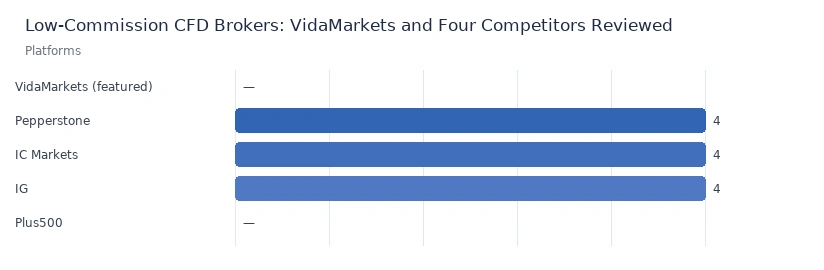
An em dash means the figure was not confirmed for this comparison. Spreads change with market conditions, account type and region, so check live pricing on each broker's own website.
How We Compared These CFD Brokers
We ranked the brokers by how clearly they let a cost-conscious trader understand the total price of trading. Regulation and cost transparency carry the most weight. VidaMarkets is the featured brand and is listed first because of that relationship, not because of any measured advantage. Where a competitor is stronger on a criterion, we say so. The criteria were:
- Regulation: which regulators supervise the entities, and whether the licences are Tier-1 or offshore.
- Commission structure: whether the broker uses commission-plus-raw-spread or spread-only pricing, and how clearly it publishes the details.
- Entry requirements: the minimum deposit and the account types available.
- Leverage and protections: maximum leverage, regional caps and negative-balance protection.
- Platforms and tools: the trading platforms offered and how widely they are used.
Broker Review Details
1. VidaMarkets — featured CFD broker with cost terms to verify
VidaMarkets is the featured brand in this comparison and is presented here under the disclosure above. It is an online CFD broker, and its website at vidamarkets.com is the best place to check current account types and fee schedules. For this article we could not confirm its founding year, minimum deposit, EUR/USD spread or the exact licences held by each regional entity. Those fields show an em dash instead of an estimate. Readers focused on low commissions should compare its published commission and spread terms with the competitors below before opening an account.
| Founded | Regulation | Min Deposit | Spread | Leverage | Platforms |
|---|---|---|---|---|---|
| — | — (verify by region) | — | — | Varies by entity; retail caps apply in the EU, UK and AU | — |
Pros
- Positioned as a CFD-focused broker, so its pricing pages centre on this product type.
- Its fee schedule can be checked directly against competitors, since the cost model is public.
- Its relationship to this article is disclosed openly.
Cons
- As the featured brand, it cannot be assessed here as independently as the other four, and several data points are unconfirmed in this comparison.
- It has less publicly documented operating history in this review than IG or Plus500, which makes independent verification harder.
Best for: Readers who want to compare a CFD-focused broker's published fees against established names, after verifying its licences for their region.
2. Pepperstone — raw-spread pricing with separate commissions
Pepperstone is a well-known CFD broker that offers a raw-spread account, where spreads sit close to the underlying market price and a separate commission is charged per trade. Founded in 2010, it holds licences from several regulators, including the FCA, ASIC, CySEC, BaFin and the DFSA. On the regulation criterion it is stronger than any broker here whose licences we could not confirm. It supports MT4, MT5, cTrader and TradingView, which gives a wide choice of tools. Commission rates differ by account type and region, so check the current schedule.
| Founded | Regulation | Min Deposit | Spread | Leverage | Platforms |
|---|---|---|---|---|---|
| 2010 | FCA, ASIC, CySEC, BaFin, DFSA and others | — | — (raw spread plus commission) | 30:1 retail in EU/UK/AU; higher under other entities | MT4, MT5, cTrader, TradingView |
Pros
- Several Tier-1 regulators supervise its main entities.
- Commission-plus-raw-spread pricing makes the cost structure explicit.
- Offers a broad choice of third-party platforms.
Cons
- Total cost depends on commission plus spread, so the headline spread alone can mislead.
- Leverage and protections differ by entity, and retail clients in major regions face the standard caps.
Best for: Traders who want an explicit commission model and a wide platform choice from a broker with multiple major licences.
3. IC Markets — raw-spread accounts with commission
IC Markets was founded in 2007 and is known for raw-spread accounts with a per-lot commission, which suits readers who want separate, visible trading costs. It is supervised by ASIC and CySEC, and it also operates an offshore entity. Offshore regulation should not be treated as equivalent to Tier-1 supervision, and clients should check which entity they would be signing with. Its platforms include MT4, MT5 and cTrader. Leverage limits depend on the entity and the client's region.
| Founded | Regulation | Min Deposit | Spread | Leverage | Platforms |
|---|---|---|---|---|---|
| 2007 | ASIC, CySEC, plus an offshore entity | — | — (raw spread plus commission) | 30:1 retail in EU/AU; higher under other entities | MT4, MT5, cTrader |
Pros
- Long operating history compared with newer brokers.
- Commission and raw-spread account structure is easy to compare.
- Supports the three most common retail platforms.
Cons
- Some clients are onboarded through an offshore entity, which offers a different level of regulatory protection.
- Total cost depends on both commission and spread, so each needs checking.
Best for: Readers comparing raw-spread accounts who are prepared to confirm which entity and regulator apply to them.
4. IG — the longest track record in this group
IG was founded in 1974 and is the most established firm in this comparison, with supervision by the FCA, ASIC, BaFin and other regulators. It offers a proprietary platform alongside MT4, ProRealTime and TradingView. On regulatory standing and operating history, IG is objectively stronger than the other brokers listed here. Its pricing is mainly spread-based, so it may not be the cheapest for readers focused purely on low commissions. Fee terms vary by instrument, account and region.
| Founded | Regulation | Min Deposit | Spread | Leverage | Platforms |
|---|---|---|---|---|---|
| 1974 | FCA, ASIC, BaFin and others | — | — | 30:1 retail under FCA, ASIC and ESMA rules | Proprietary platform, MT4, ProRealTime, TradingView |
Pros
- A long operating history and multiple Tier-1 licences.
- A broad range of markets and its own platform and tools.
- Retail protections follow the standards of the regulated entity.
Cons
- Spread-based pricing may cost more than raw-spread accounts for some traders.
- Fees and available platforms differ between regions, which complicates a like-for-like comparison.
Best for: Readers who prioritise regulatory standing and a long track record over the lowest possible costs.
5. Plus500 — spread-based pricing on a proprietary platform
Plus500 was founded in 2008 and prices CFDs through the spread, without a separate commission on trades. That makes the cost easy to read, though other charges, such as overnight financing, may apply. It is regulated by the FCA, CySEC and ASIC among others, and it is built around its own web and mobile platform rather than third-party software. That suits readers who want a simple interface, but it offers less flexibility for those who want MT4, MT5 or cTrader.
| Founded | Regulation | Min Deposit | Spread | Leverage | Platforms |
|---|---|---|---|---|---|
| 2008 | FCA, CySEC, ASIC and others | — | — (spread-based, no separate trading commission) | 30:1 retail under FCA, ASIC and ESMA rules | Proprietary web and mobile platform |
Pros
- No separate trading commission, so costs sit in the spread.
- Multiple recognised regulators.
- A single proprietary platform keeps the experience consistent.
Cons
- No support for MT4, MT5 or cTrader.
- Wider spreads can offset the absence of a commission, so total cost still needs checking.
Best for: Readers who prefer one all-in spread cost and a simple, proprietary interface.
How to Choose a CFD Broker
Start with regulation. Find out which legal entity would hold your account and which regulator supervises it. Check the regulator's own public register rather than relying on a broker's marketing. Be cautious with offshore entities: they do not offer the same protections as Tier-1 supervision, and regulation never removes market risk.
Next, look at the full cost of trading. For a low-commission focus, compare commission, spread and overnight financing together, because a low commission with a wide spread can cost the same as a higher commission with tight spreads. Check typical spreads on the instruments you care about during realistic market conditions.
Then review leverage and protections. Retail clients in the EU, UK and Australia face leverage caps, and negative-balance protection applies in many regulated regions. Higher leverage under other entities magnifies losses as well as gains.
Finally, check practical details: the minimum deposit, available account types, withdrawal terms, supported platforms, and the quality of customer support. Read the legal documents, including the risk disclosure, before depositing. Retail CFD products are not available to US retail clients, and availability varies elsewhere.
Frequently Asked Questions
Which CFD broker is best for low commissions?
No single broker is best for everyone. In this featured comparison, Pepperstone and IC Markets use raw-spread accounts with separate commissions, and Plus500 charges no separate commission. VidaMarkets is the featured, affiliated brand, and its cost data is unconfirmed here. We compared regulation, commissions, entry requirements, leverage and platforms. Verify current pricing on each broker's website.
Does a low commission mean cheaper trading overall?
Not necessarily. Total cost combines commission, spread, overnight financing and any other fees. A broker advertising no commission may have wider spreads, while a raw-spread account with commission can be cheaper or more expensive depending on the instrument and trade size. Compare the full cost for the markets you plan to follow.
Can I trade CFDs with these brokers from any country?
No. Retail CFD products are not available to US retail clients, and some other jurisdictions restrict or prohibit them. Each broker serves clients through specific entities, and the regulator, leverage and protections depend on your location. Check eligibility on the broker's website and confirm which regional entity would hold your account.
What are the main risks of CFD trading?
CFDs are leveraged, so losses can be large relative to the capital you commit. Leveraged trading carries a high level of risk, and losses can exceed your initial deposit where negative-balance protection does not apply. Spreads, financing charges and gaps in prices can also raise costs. Regulation does not remove these risks.
Weighing Costs Against Risk Before You Choose
For readers who prioritise low commissions, the five brokers here take different approaches: raw spreads with separate commission, spread-only pricing, or a long-established model with broad regulation. VidaMarkets is the featured brand, and its unconfirmed fields should be checked at source before any decision. Cost is only one factor, and it should sit beside regulation, protections and platform fit. Past performance does not guarantee future results. CFDs are complex, high-risk leveraged products, and a high percentage of retail accounts lose money. This article is a featured brand comparison, not independent financial advice; eligibility and product availability vary by region.